University of Amsterdam Receives NWO Funding for Cutting-Edge Light-Induced Materials Degradation Study
 Formfees
17/01/2025
Formfees
17/01/2025

ConSOLIDATe will combine advanced analytical instrumentation, light-exposure technology and sophisticated data-analysis techniques to provide fundamental insights into the light-degradation mechanisms of essential compounds in various materials. The team consists of analytical chemists Dr Saer Samanipour and Dr Bob Pirok at the UvA’s Van ‘t Hoff Institute for Molecular Sciences (HIMS), and Prof. Govert Somsen and Dr Freek Ariese of the Vrije Universiteit Amsterdam (VUA), respectively from the Division of Bioanalytical Chemistry and the Section Biophotonics and Medical Imaging. The project is coordinated by Van Bommel, who holds positions at both the Faculty of Science and the Faculty of Humanities at the UvA.
Highly challenging research questions
Many materials are affected by light. Hence, products may lose their functional, health-related and/or aesthetic properties, which can have huge industrial, environmental and societal consequences. Yet, understanding the chemistry of light-induced degradation (LID) is highly challenging. This is due to the complexity of the – often heterogeneous – materials, and the many environmental aspects that can play a role. Current technology to study LID is time-consuming, prone to errors, and does not always provide adequate chemical knowledge.
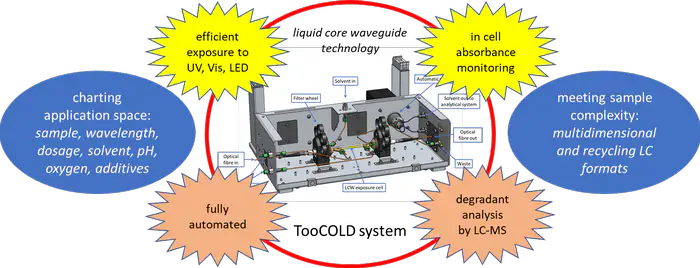
ConSOLIDATe aims to create a better understanding of LID for a wide range of materials, including comprehension of the effects of ambient parameters such as temperature, relative humidity, oxygen, solvents, pH, and additives. The team has developed a fully automated tool to study LID in solutions, integrating light exposure and on-line absorption monitoring with characterization of degradation products by liquid chromatography-mass spectrometry. It reduces study times from months/weeks to days or even hours thanks to a highly efficient sample irradiation and the ability to readily evaluate relevant variables. This uniquely enables tackling two crucial research questions: how do materials degrade in different sample states (i.e. in solution or solid phase); and what is the (extent of) correlation between these processes?
Two PhD candidates and a postdoc
In ConSOLIDATe two PhD candidates and a post-doc will design and apply new workflows using two-dimensional liquid-chromatographic and (sub)surface Raman techniques, to study LID of various materials in solution and solid phase under different conditions. They will also develop novel computational tools to comprehend and predict degradation pathways, and corroborate relations between degradation products formed in liquid and solid phase.
The research will be carried out within the Centre for Analytical Science Amsterdam (CASA, in which UvA and VU join forces) and in collaboration with LaserLab Amsterdam (hosted at VUA, with participating research groups at UvA, AMC and VUmc). Other partners are AstraZeneca, AkzoNobel, the Cultural heritage agency of The Netherlands (RCE) and KWR Watercycle Research Institute. A user committee will be formed comprising representatives from the Rijksmuseum, Unilever, Covestro and Het waterlaboratorium.