New milestone in indigenous development of gaseous detector important for mega science FAIR project in Germany
 Formfees
08/02/2025
Formfees
08/02/2025


Researchers have developed an innovative technique using a radioactive source that can simplify the study of radiation effects on Gas Electron Multiplier (GEM) detectors, a crucial step in nuclear and particle physics experiments.
Gas Electron Multiplier (GEM) detector are particle detectors used as tracking devices in high-energy physics experiments that utilizes a thin, perforated foil with a high electric field to amplify particles produced by ionizing radiation, allowing for precise detection of particles like muons by significantly multiplying the initial signal generated by the particle’s interaction with the gas within the detector.
They are also strong candidates for diagnostic applications in medical technology because of their good position resolution. First introduced by Prof. Fabio Sauli in 1997, GEM detectors consist of a 50 μm thick Kapton foil, with 5 μm copper cladding on both sides.
Despite their advantages, the inclusion of Kapton, a radiation-resistant polyimide film with excellent insulating properties, in the active volume makes these detectors sensitive to radiation-induced effects, particularly the charging-up of the dielectric medium. During operation, ionizing radiation deposits energy into the detector, initiating electron avalanche formation.
This process results in charge accumulation on the Kapton foil, which in turn enhances the electric field within the GEM holes—the primary region for electron multiplication. This increase in the electric field boosts the detector’s gain and efficiency. Over time, a dynamic equilibrium is established, stabilizing the gain and ensuring consistent detector performance.
India has the full responsibility of building all the GEM chambers that will be used in the future Compressed Baryonic Matter (CBM) experiment at FAIR and will be operated at very high radiation environment. For this, it is important to enhance the understanding of the charging-up effect in GEM detectors, a phenomenon that remains inadequately understood.
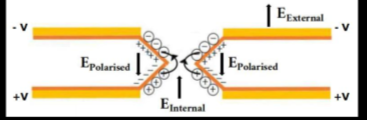
Fig 1: Schematic of the charge accumulation on the Kapton foil inside GEM hole. The dynamical accumulation of the charges on the surface of the Kapton increases the electric field thence the gain of the chamber.
To investigate this phenomenon, Dr. Saikat Biswas and his PhD student, Dr. Sayak Chatterjee along with the other collaborators from the Bose Institute, an autonomous institution under the Department of Science and Technology (DST), Government of India, conducted an in-depth investigation into the charging-up effect on the Kapton foil and its subsequent impact on detector performance.
The team from Department of Physical Sciences at Bose Institute, developed a specialized experimental setup to study the charging-up effect in triple GEM detectors by studying its gain variation as a function of time.
Analysis of the charging effect indicated that as either the detector gain (the ratio of the primary charges to the charges detected by the readout board) or irradiation rate increased, the charging-up time decreased significantly. This behavior was attributed to higher particle densities, which facilitated faster charge equilibrium within the GEM holes.
(b)
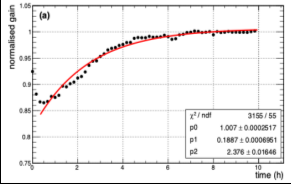
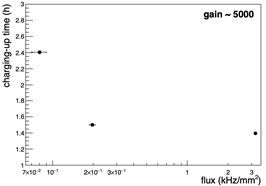
Fig 2: (a) Variation of the normalized gain as a function of time fitted with a polynomial function to extract the charging-up time (p2) of a DM triple GEM chamber. (b) Variation of charging-up time of the DM triple GEM chambers as a function of the irradiation rates from a Fe-55 source at a fixed detector gain of ~ 5000.
The findings from this study provide valuable insights for predicting behavioral changes in GEM detectors, critical components in high-rate experiments, when subjected to external radiation. These insights will inform design considerations and operational parameters for GEM chambers in radiation-intensive environments such as the CBM experiment at FAIR, Germany. These results are not only important for CBM experiment only but also for other high-rate experiments where GEM will be used.
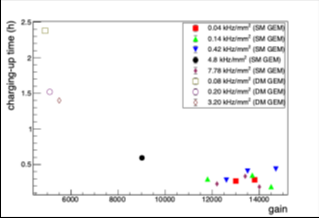
Fig 3: Variation of charging-up time of the DM & SM triple GEM chambers as a function of the gain of the chambers for different irradiation rates using the Fe-55 X-ray source.
The researchers plan to extend their work to investigate the impact of GEM foil geometry on the charging-up effect and to explore behavioral changes under various types of irradiations, extending beyond the capabilities of laboratory setups. The studies published in the Journal of Instrumentation & Nuclear Instruments and Methods in Physics Research Section A, are crucial milestones for indigenous gaseous detector development.