India’s Silent Shift Towards Inclusive Education: How Private Schools Are Opening Doors for Children with Special Needs
 Formfees
21/03/2025
Formfees
21/03/2025
Contents
- 1 What Happens When Every Child Gets a Fair Chance to Learn?
- 2 What Is Inclusive Education?
- 3 Why Private Schools Matter in This Journey
- 4 How Is the System Supporting Inclusion?
- 5 What Are the Benefits of Inclusive Education?
- 6 Challenges That Still Need Attention
- 7 How Can Parents and Schools Help?
- 8 Quick Link :
- 9 FAQs: Understanding Private School Inclusion in India
- 10 Final Thoughts: A Future Where Every Child Belongs
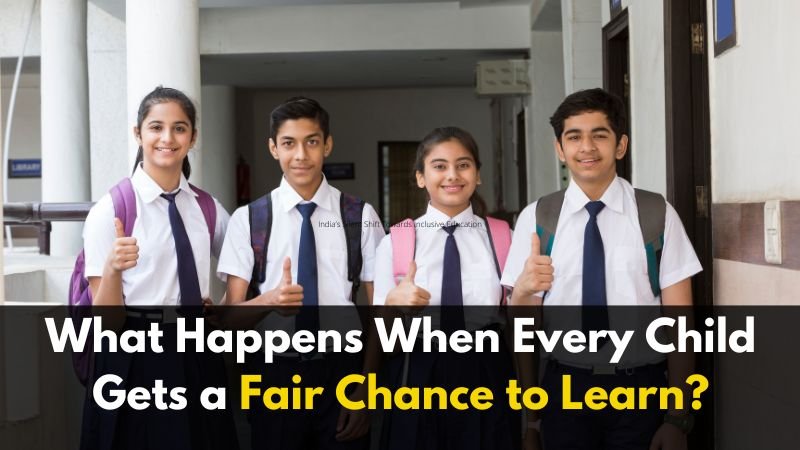
What Happens When Every Child Gets a Fair Chance to Learn?
For years, many parents of children with special needs in India felt helpless. They wanted their kids to go to good schools, to sit in regular classrooms, to learn and grow like every other child. But they often heard no — sometimes politely, sometimes directly. The dream of equal education seemed far away.
But something important is changing.
Today, private schools are finally starting to include children with special needs, not just because the law says so, but because the system is slowly learning that every child deserves to belong.
What Is Inclusive Education?
Inclusive education simply means that children with and without disabilities learn together in the same classroom. It doesn’t mean giving everyone the same treatment — it means giving each child what they need to succeed.
A child who uses a wheelchair may need ramps and wider doors. A child with autism may need extra time to finish a test. A child with a learning difficulty may need special teaching tools.
Inclusion is not about fitting in — it’s about making space for everyone.
Why Private Schools Matter in This Journey
Private schools in India are often better equipped with infrastructure, teaching staff, and technology. If they become more inclusive, they can set a strong example for others.
Here’s what private schools can offer:
- Classrooms that support different learning styles
- Trained teachers who understand how to work with special needs
- Buildings that are accessible to all children
- A school culture that promotes empathy and respect
This is why it’s so important that private schools take the lead in building inclusive spaces.
How Is the System Supporting Inclusion?
Laws like the Right to Education (RTE) Act say that private schools must reserve a certain number of seats for children with special needs. To make things fair, the government uses a lottery or “draw of lots” system. This ensures:
- No child is left out because of bias
- The process is open and honest
- Parents from all walks of life get a fair chance
These changes are helping more and more children find their place in good schools — without being rejected just because they are “different”.
What Are the Benefits of Inclusive Education?
Inclusive education is not just good for children with special needs — it’s good for everyone.
Here’s why:
| For Children with Special Needs | For Other Children |
|---|---|
| Feel accepted and confident | Learn empathy and kindness |
| Get the support they need | Understand differences |
| Build social skills | Become better team players |
| Improve in academics over time | Develop emotional intelligence |
Inclusion builds stronger, kinder classrooms — and better citizens for tomorrow.
Challenges That Still Need Attention
While the progress is real, there are still issues that need to be fixed:
- Many schools lack trained special educators
- Not all buildings are fully accessible
- Some teachers and parents still don’t understand what inclusion means
- Monitoring is weak in some places
But these are not reasons to stop — they are reasons to work harder.
How Can Parents and Schools Help?
For Parents:
- Learn more about your child’s rights under the RTE and RPWD Acts
- Visit schools and ask about their inclusion policies
- Join support groups to connect with other parents
For Schools:
- Train teachers in inclusive practices
- Hire special educators and counselors
- Make school buildings accessible to all
- Talk to students about kindness and respect
When schools and parents work together, every child can thrive.
Quick Link :
NEP Language Debate Heats Up: Education Ministry Clarifies – “No Plan to Impose Any Language”
FAQs: Understanding Private School Inclusion in India
Can children with special needs join private schools?
Yes. The RTE Act makes it mandatory for private schools to admit children with special needs under a reserved quota.
Is the selection process fair?
Yes. Most states use a computerized lottery system to make sure the selection is fair and free from bias.
What support will my child get in a private school?
This depends on the school. Some have special educators, counselors, ramps, and learning aids. It’s best to visit and ask.
Will my child feel left out?
Inclusive classrooms are designed to help every child feel safe and valued. With proper support, your child can be part of a friendly and welcoming environment.
Final Thoughts: A Future Where Every Child Belongs
Imagine a classroom where a child in a wheelchair shares lunch with a child who stutters. Where a child with Down syndrome solves puzzles with a child who reads fast. Where no one is “less than” — just different.
That future is not a dream. It’s already happening, slowly but surely.
When we include every child, we build a better world — not just for them, but for all of us.