Chandrayaan-3: Over 2 Crore UP Students Witnessed the Soft Landing On The Moon Says UP Government
 Formfees
17/01/2025
Formfees
17/01/2025
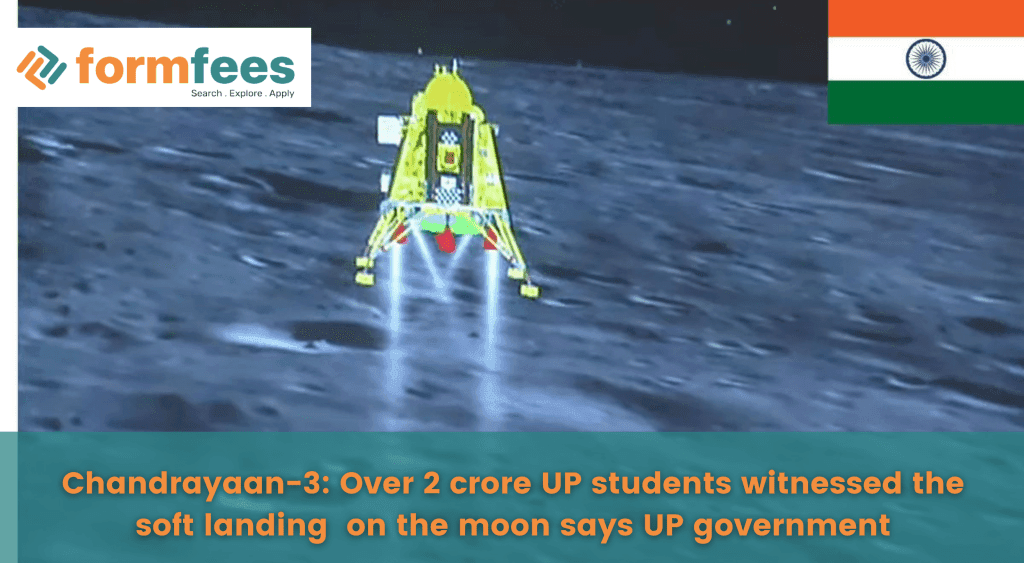
On August 23, school children in Uttar Pradesh saw the historic Chandrayaan-3 mission’s gentle lunar landing. More than two crore students from both public and private schools in the state watched the live telecast of the proceedings, according to the UP government.
In order to witness the Chandrayaan-3 landing, the government first opened the schools in the evening, and a special assembly was held to commemorate the occasion.
The government claims that projectors and televisions were set up in the schools for the live telecast of Chandrayaan-3. Additionally, plans were created to show it to kids in smart classrooms and on computers. The children were given all the information they required about the Chandrayaan-3 mission by the teachers at their individual schools.
According to Vijay Kiran Anand, secretary of the Basic Education Department in the state of Uttar Pradesh, Chandrayaan-3’s successful landing was televised live in every school in the region. The schoolchildren received thorough information on the project and were motivated to participate in space missions and pursue scientific studies.
All of the nation’s higher education institutions had been invited by the University Grants Commission (UGC) to broadcast the event for student viewing. “Chandrayaan-3 serves as a moving reminder; a deeply touching tribute to our scientific capabilities and visionary action,” stated M. Jagadesh Kumar, chairperson of the University Grants Commission. The UGC and the educational community extend sincere greetings to ISRO.
About Chandrayaan 3:
With the aim of researching and showcasing new technology necessary for interplanetary missions, Chandrayaan-3 is made up of an indigenous Lander module (LM), Propulsion module (PM), and Rover.
The Lander will be able to soft land at a chosen location on the moon and release the Rover, which will conduct in-situ chemical analysis of the lunar surface while it is moving. There are scientific payloads on the Lander and the Rover that will conduct lunar surface tests.
The main job of PM is to transport the LM from injection into the launch vehicle to the final 100 km circular polar orbit of the moon and then to release the LM from PM.
In addition to this, the Propulsion Module carries a scientific payload that will operate when the Lander Module separates. LVM3 M4 has been identified as the launch vehicle for Chandrayaan-3, and it will deposit the integrated module in an Elliptic Parking Orbit (EPO) with a dimension of approximately 170 x 36500 km.
The Goals of Chandrayaan-3’s Mission Are:
- To show Safe and Soft Landing on the Surface of the Moon
- To showcase roving lunar rover technology
- to carry out in-situ scientific research.
Following are Chandrayaan-3’s General Specifications:
| Sl No. | Parameter | Specifications |
|---|---|---|
| 1 | Mission Life (Lander & Rover) | One lunar day (~14 Earth days) |
| 2 | Landing Site (Prime) | 4 km x 2.4 km 69.367621 S, 32.348126 E |
| 3 | Science Payloads | Lander:Radio Anatomy of Moon Bound Hypersensitive ionosphere and Atmosphere (RAMBHA) Chandra’s Surface Thermo physical Experiment (ChaSTE) Instrument for Lunar Seismic Activity (ILSA) Laser Retroreflector Array (LRA) Rover: Alpha Particle X-Ray Spectrometer (APXS) Laser Induced Breakdown Spectroscope (LIBS) Propulsion Module: Spectro-polarimetry of HAbitable Planet Earth (SHAPE) |
| 4 | Two Module Configuration | Propulsion Module (Carries Lander from launch injection to Lunar orbit) Lander Module (Rover is accommodated inside the Lander) |
| 5 | Mass | Propulsion Module: 2148 kg Lander Module: 1752 kg including Rover of 26 kg Total: 3900 kg |
| 6 | Power generation | Propulsion Module: 758 W Lander Module: 738W, WS with Bias Rover: 50W |
| 7 | Communication | Propulsion Module: Communicates with IDSN Lander Module: Communicates with IDSN and Rover. Chandrayaan-2 Orbiter is also planned for contingency link. Rover: Communicates only with Lander. |
| 8 | Lander Sensors | Laser Inertial Referencing and Accelerometer Package (LIRAP) Ka-Band Altimeter (KaRA) Lander Position Detection Camera (LPDC) LHDAC (Lander Hazard Detection & Avoidance Camera) Laser Altimeter (LASA) Laser Doppler Velocimeter (LDV) Lander Horizontal Velocity Camera (LHVC) Micro Star sensor Inclinometer & Touchdown sensors |
| 9 | Lander Actuators | Reaction wheels – 4 nos (10 Nms & 0.1 Nm) |
| 10 | Lander Propulsion System | Bi-Propellant Propulsion System (MMH + MON3), 4 nos. of 800 N Throttleable engines & 8 nos. of 58 N; Throttleable Engine Control Electronics |
| 11 | Lander Mechanisms | Lander leg Rover Ramp (Primary & Secondary) Rover ILSA, Rambha & Chaste Payloads Umbilical connector Protection Mechanism, X- Band Antenna |
| 12 | Lander Touchdown specifications | Vertical velocity: ≤ 2 m / sec Horizontal velocity: ≤ 0.5 m / sec Slope: ≤ 12 deg |
For the most recent information about colleges and universities, entrance, programs, tests, schools, research, NEP, and other educational policies, follow us. Write to us at news@formfees.com if you want to get in touch.